
Last reviewed: August 2026
What Cannot Be Shipped Internationally from Japan?
The most expensive time to discover a shipping restriction is after you have paid for the item. Export rules, carrier rules and destination-country import rules all apply, and the strictest one wins.
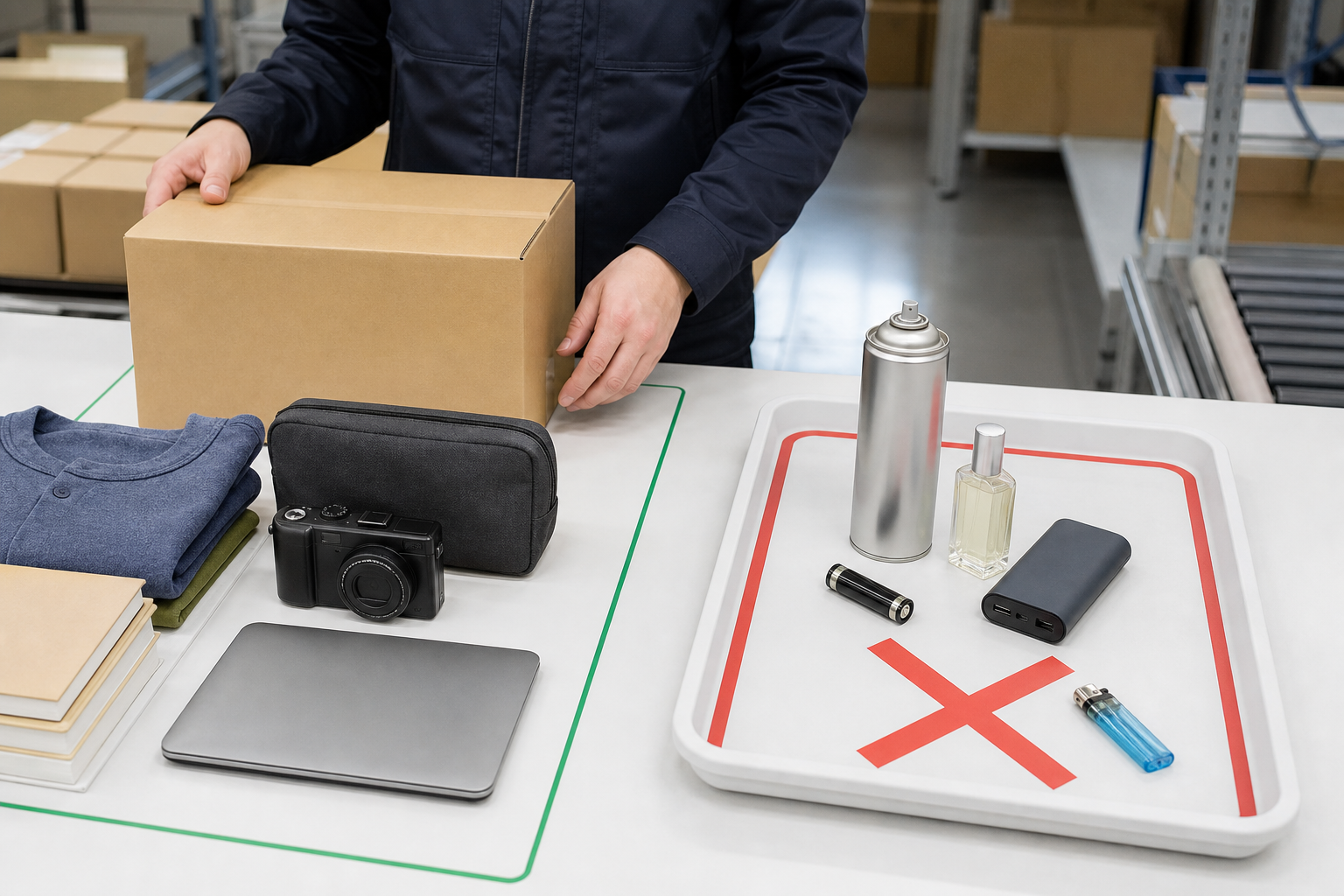
Common problem categories
| Category | Examples | Typical issue |
|---|---|---|
| Flammable liquids | Perfume, nail polish, some paints and solvents | Dangerous goods restrictions, especially by air |
| Aerosols and gases | Spray cans, compressed gas, some cosmetics | Pressurized or flammable contents |
| Lithium batteries | Power banks, loose rechargeable cells, devices with batteries | Configuration, capacity, packing and carrier restrictions |
| Ignition items | Lighters, matches and fuel | Fire risk |
| Alcohol and chemicals | High-alcohol products, cleaning agents, hair tonic | Flammability or destination regulation |
| Weapons and controlled goods | Firearms, realistic replicas, certain blades | Export, carrier and import law |
| Food, plants and animal products | Fresh food, seeds, untreated wood, some leather | Quarantine and biosecurity |
| Counterfeit or protected goods | Replicas, prohibited cultural or wildlife products | Intellectual-property, customs or treaty controls |
Lithium batteries need precise answers
“Contains a battery” is not enough. The shipper may need to know whether the battery is installed in equipment, packed beside equipment or shipped alone; whether it is lithium-ion or lithium metal; its capacity; condition; and quantity. Damaged, swollen or recalled batteries are especially problematic. Power banks are generally treated as batteries rather than equipment.
Three separate rulebooks
- Japan export and aviation rules: determine whether the item can leave Japan and travel by the chosen mode.
- Carrier acceptance rules: Japan Post, an express courier and a freight forwarder may accept different products.
- Destination rules: customs, food, health, radio, product-safety and other agencies may restrict import even when transport is possible.
Check before purchase
- Find the manufacturer’s ingredient list, battery specification or safety data sheet.
- Send the exact product URL and model to the shipping service.
- Ask whether an alternative surface or specialist dangerous-goods route exists.
- Confirm whether the destination allows personal and commercial quantities.
- For resale, check labeling, certification and consumer-safety requirements separately.
If a parcel is rejected
Possible outcomes include domestic return to the seller, removal of a component with permission, disposal, separate shipping or storage charges. None is guaranteed. This is why restricted-product screening belongs before purchase, not after warehouse arrival.
Official reference
Start with Japan Post’s current international mail restrictions and country and territory conditions. Then check the selected carrier and destination customs authority.
Found an item in Japan?
Send the product link and destination country. We will review availability, shipping restrictions and the likely cost structure before you proceed.