
Last reviewed: August 2026
How to Buy Japanese Ceramics and Tableware Wholesale
Japanese ceramics can create a distinctive retail assortment, but wholesale buying involves more than selecting attractive glazes. Ask about production region, maker, case quantities, food-contact documentation, acceptable variation and how each shape survives export.
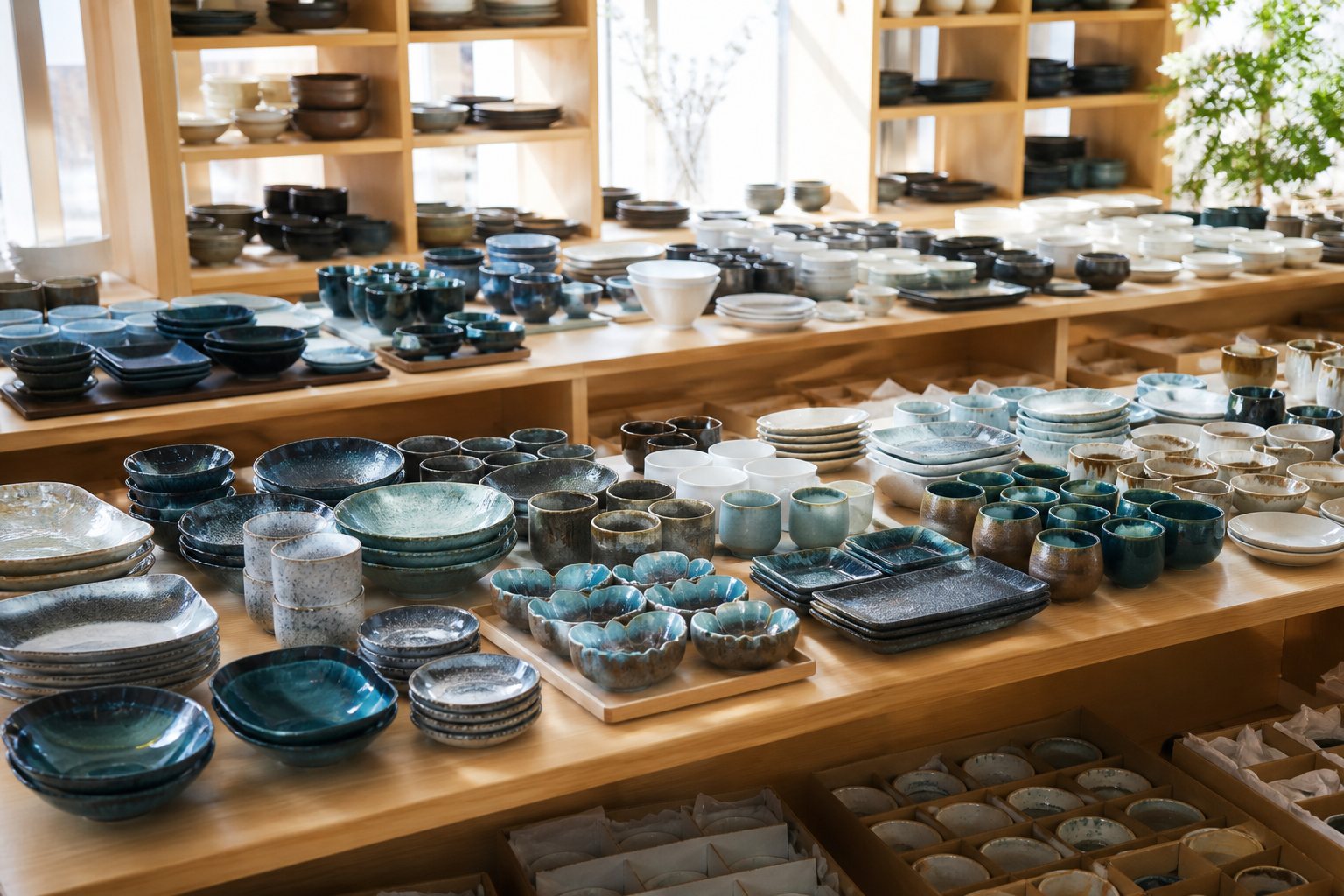
Common sourcing routes
Manufacturers and kilns offer product knowledge and stronger provenance, but may have production minimums. Regional wholesalers can combine several makers and lower the practical order threshold. Trade shows and industry associations are useful for discovery. Domestic retail sourcing may work for testing, but it rarely provides stable replenishment or wholesale margin.
Specify the product accurately
- Item code, shape, dimensions, capacity and weight
- Clay/body, glaze and firing method where commercially relevant
- Microwave, dishwasher and oven claims with supporting basis
- Food-contact or material documentation required in your market
- Units per inner and master carton
- Barcode, retail box and country-of-origin labeling
Acceptable variation versus defect
| Feature | Possible acceptable variation | Possible defect |
|---|---|---|
| Glaze | Natural tone, flow or speckle variation | Bare area or contamination outside the approved range |
| Shape | Slight handmade irregularity | Unsafe wobble, severe warp or poor stacking |
| Surface | Characteristic pinholes within standard | Sharp projection, crack or unstable repair |
| Color | Batch variation shown in references | Wrong colorway or extreme mismatch |
| Rim/foot | Expected artisan finish | Chip, sharp edge or rocking base |
Samples and production timing
Order samples of each shape, not only each glaze: plates, cups and tall vessels fail differently in shipping. Confirm whether the sample is from stock or a future firing. Handmade production can have seasonal lead times, and exact repeat colors may not be possible.
Export packing
- Use dividers or molded protection so pieces cannot strike each other.
- Protect handles, rims and projecting feet.
- Check carton weight; dense tableware can overload large boxes.
- Test inner cartons as units and use a stronger export master carton.
- Plan a small replacement quantity for wholesale customers.
Build the wider process: How to Buy Wholesale Products from Japan →
Best first order
Choose a coordinated but limited range with shared packaging dimensions and realistic case packs. Test customer response, damage rate and replenishment time before adding many shapes. A smaller repeatable assortment is usually healthier than a beautiful one-time catalog.
Have a sourcing brief?
Tell us the product, target quantity, destination and target cost. We will explain what can be researched, sampled, inspected and shipped.